

Core Strength for Faster Swimming, Cycling and Running
Most triathletes think core training is about getting stronger abs. In reality, a strong core helps transfer power, improve efficiency and maintain technique across swimming, cycling and running. Discover why core strength matters and how it can help you become a faster, more resilient triathlete.
Ask a group of triathletes what they think core training is and you'll often hear the same answers:
"Planks."
"Sit-ups."
"Ab exercises."
While those exercises can have a place, they barely scratch the surface of what core strength actually means.
For triathletes, core strength is not about having visible abs or completing endless crunches.
It's about creating a stable platform that allows you to swim more efficiently, ride more powerfully and run more economically.
At FrederickWebbTriathlon, core training forms an important part of many athletes' strength programmes because the benefits extend far beyond the gym.
A stronger core won't magically knock minutes off your race time overnight.
But it can help you transfer power more effectively, maintain technique under fatigue and reduce the risk of performance-limiting injuries.
In a sport where efficiency matters, those benefits add up.
What Is Your Core?
Many people think the core refers only to the abdominal muscles.
In reality, the core is a much larger system.
It includes muscles around the:
Abdomen
Lower back
Pelvis
Hips
Deep stabilising muscles of the trunk
Together, these muscles help stabilise the body and transfer force between the upper and lower body.
Think of the core as the bridge connecting everything together.
Without a strong bridge, power leaks occur.
And in endurance sport, small leaks repeated thousands of times can significantly impact performance.
Why Core Strength Matters for Triathletes
Triathlon is all about efficiency.
The athlete who wastes the least energy often performs best.
A strong and stable core helps:
Maintain posture
Transfer force efficiently
Improve movement quality
Resist fatigue
Support breathing mechanics
Reduce unnecessary movement
These qualities influence all three disciplines.
Let's look at each one individually.
Core Strength for Faster Swimming
Swimming is often where core strength has the most obvious impact.
Many swimmers focus heavily on their arms and shoulders.
But the reality is that swimming is a whole-body movement.
A strong core helps you:
Maintain a Better Body Position
One of the biggest causes of drag in swimming is poor body alignment.
When the hips and legs drop, resistance increases.
A strong core helps maintain a more streamlined position in the water.
Less drag means greater efficiency.
And greater efficiency means more speed for the same effort.
Improve Rotation
Efficient freestyle swimming relies on controlled body rotation.
Core muscles help transfer force between the upper and lower body during each stroke.
Better rotation often leads to:
Improved stroke mechanics
Better catch position
More effective propulsion
Maintain Technique Under Fatigue
Many athletes swim well at the start of a session but lose technique as fatigue develops.
Core endurance helps maintain posture and body control when tired.
This can be particularly valuable during open-water swimming and long-distance races.
Core Strength for Faster Cycling
Cycling may appear to be a leg-dominant sport.
But core strength plays a significant role in power production and efficiency.
Creating a Stable Platform
Your legs generate power.
Your core helps transfer that power into the bike.
Without adequate stability, some of that force can be lost through unnecessary movement.
A stronger core provides a more stable platform from which the legs can work.
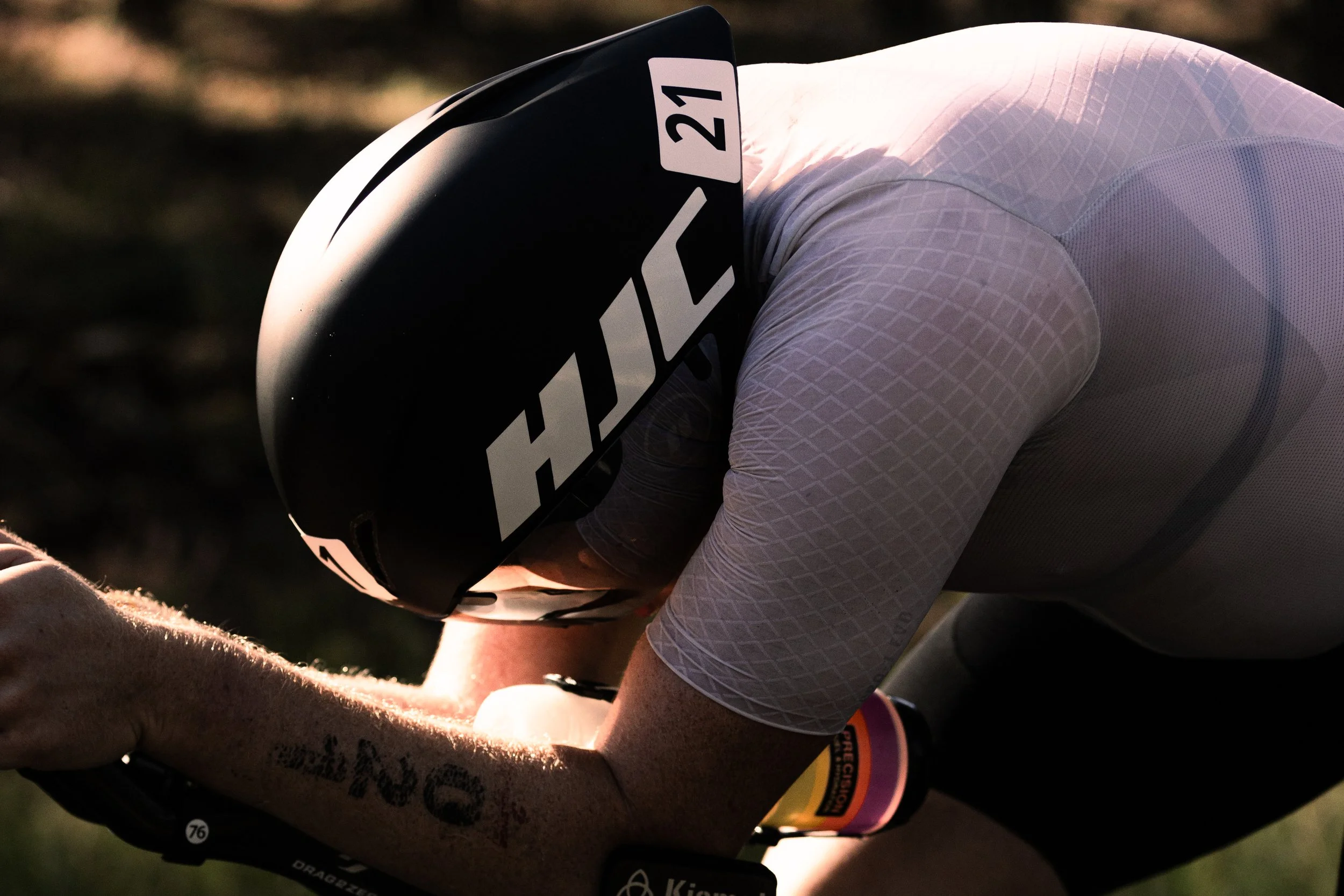
Maintaining an Aero Position
Triathletes spend significant time in aerodynamic positions.
Holding this position requires more than flexibility.
It requires strength.
A weak core can make it difficult to maintain an efficient aero position for prolonged periods.
The result may be:
Reduced comfort
Increased fatigue
Poorer aerodynamics
A stronger core can help athletes stay comfortable and efficient for longer.
Reducing Upper-Body Fatigue
A stable torso allows the upper body to remain relaxed while riding.
This can improve comfort during long rides and Ironman events.
Core Strength for Faster Running
Running economy is one of the most important predictors of endurance performance.
Core strength can contribute to improved running economy in several ways.
Better Posture
As fatigue builds during a run, posture often deteriorates.
Athletes may:
Slouch
Over-rotate
Lose stability
A stronger core helps maintain posture and movement quality.
Improved Force Transfer
Running involves transferring force through the body with every stride.
A stable trunk can improve the efficiency of this process.
While core training won't suddenly transform your running pace, improved force transfer can contribute to better movement efficiency over time.
Reduced Excessive Movement
Unnecessary movement wastes energy.
Core strength can help minimise excessive side-to-side movement and improve control.
Small improvements in efficiency become increasingly valuable over long distances.
Core Strength and Injury Prevention
One of the most overlooked benefits of core training is injury resilience.
A strong core helps athletes maintain control during repetitive movement.
This may reduce excessive loading in other areas such as:
Lower back
Hips
Knees
Core training should never be viewed as a guarantee against injury.
However, it can form an important part of a wider strength and conditioning programme designed to improve robustness.
The Biggest Core Training Mistake
Most triathletes make the same mistake:
They focus exclusively on movement.
Hundreds of sit-ups.
Endless crunches.
Constant twisting exercises.
The core's primary role is often to resist movement rather than create it.
This is why exercises such as planks and anti-rotation movements are often valuable.
The goal isn't simply to move your trunk.
It's to control it.
The Best Core Exercises for Triathletes
There is no single perfect exercise.
However, some movements consistently provide excellent value for triathletes.
Plank Variations
Simple but effective.
Planks develop trunk stability and endurance.
Side Planks
Excellent for lateral stability and hip control.
Dead Bugs
Great for developing coordination and trunk control.
Pallof Presses
A highly effective anti-rotation exercise.
Bird Dogs
Develop stability while challenging balance and coordination.
Loaded Carries
One of the most underrated exercises available.
Carries develop whole-body stability and core strength simultaneously.
Farmer's Walks
Particularly useful for improving postural control and resilience.
More Core Training Isn't Always Better
Some athletes assume they need to train their core every day.
Usually, they don't.
Core training should complement your overall programme.
For most triathletes, two to three focused sessions per week are more than sufficient.
Remember:
Quality matters more than quantity.
A well-designed 10-minute core routine often provides more benefit than 30 minutes of random exercises.
Core Strength Is Only Part of the Picture
A strong core alone won't make you a fast triathlete.
You still need:
Swim training
Bike training
Run training
Strength training
Recovery
Nutrition
Core work should support these areas rather than replace them.
Think of core training as improving the foundation that allows everything else to work more effectively.
How Core Training Fits Into a Triathlon Programme
At Frederick Webb Triathlon, core training is integrated into a broader strength and conditioning programme.
The goal is not simply to create stronger abdominal muscles.
The goal is to improve performance.
Core work is often combined with:
Strength exercises
Stability work
Mobility training
Injury prevention strategies
This ensures every exercise serves a clear purpose.
What Does the Research Say?
Research consistently shows that strength training can improve endurance performance when appropriately integrated into a triathlon programme.
Core training forms part of that wider picture.
While core exercises alone are unlikely to produce dramatic improvements, they can contribute to:
Better movement efficiency
Improved posture
Enhanced force transfer
Greater resilience
Combined with swim, bike and run training, these benefits can support long-term performance development.
Why Many Triathletes Ignore Core Training
Core training isn't glamorous.
You can't easily show it off on social media.
It doesn't produce impressive power numbers.
And it certainly isn't as exciting as a long ride or track session.
But many of the best athletes consistently include it because they understand its role in supporting performance.
The gains may be small individually.
Collectively, they matter.
Final Thoughts
Core strength isn't about six-pack abs.
It's about creating a stable, efficient athlete capable of transferring power effectively across swimming, cycling and running.
A stronger core can help:
✔ Improve swimming position and rotation
✔ Support aerodynamic cycling positions
✔ Enhance running posture and efficiency
✔ Reduce unnecessary movement
✔ Improve resilience and durability
Most importantly, it helps provide the foundation that allows your swim, bike and run training to be more effective.
At Frederick Webb Triathlon, strength and conditioning programmes are designed specifically for endurance athletes, ensuring every exercise contributes to better performance on race day.
Whether you're preparing for your first sprint triathlon, an Ironman, or targeting British Age Group qualification, developing a stronger core can be an important part of becoming a faster, more durable athlete.
Ready to train smarter and build a stronger foundation for performance? Get in touch with FrederickWebb Triathlon today.
FAQ: Core Strength for Triathletes
Does core training make you faster?
Core training alone is unlikely to produce dramatic improvements, but it can improve efficiency, posture and force transfer, all of which contribute to performance.
How often should triathletes train their core?
Most athletes benefit from two to three focused core sessions per week integrated into a wider strength programme.
Are planks enough for triathlon core training?
Planks are useful, but a complete programme should include a variety of stability and anti-rotation exercises.
Can core training help prevent injuries?
Core strength may improve movement control and resilience, making it a valuable component of an injury prevention strategy.
What is the best core exercise for triathletes?
There is no single best exercise. Planks, side planks, Pallof presses, dead bugs and loaded carries are all highly effective options.